
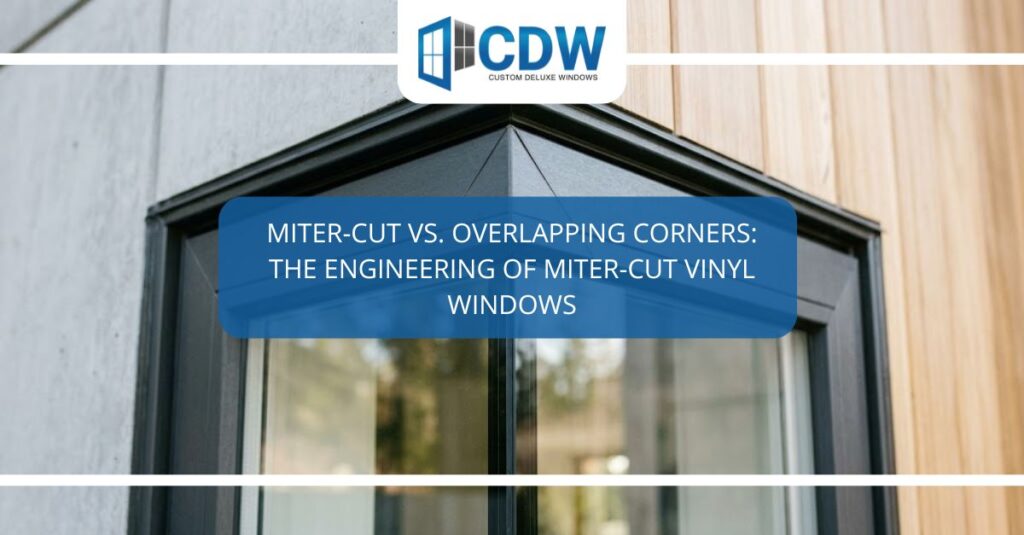
The way a frame is joined at its corners can influence how the entire unit looks and performs over time. Miter cut vinyl windows are just one of the methods we use to create a strong, clean frame.

How a Miter-Cut Corner Is Formed
A mitered corner begins with two frame sections cut at precise 45-degree angles. They meet to create a 90-degree corner and are fusion-welded together. The result is a continuous thermoplastic frame rather than two pieces simply placed against each other.
Industry guidance recognizes welded thermoplastic corners as an area of quality control. The Fenestration and Glazing Industry Alliance maintains guidance addressing inspection and quality of welded vinyl corners, reflecting the role corner weld integrity can play in product performance.
Fusion Welding Versus Mechanical Overlap
What Happens at the Joint
With miter cut vinyl windows, angled frame members are joined through fusion welding to create a continuous connection between the vinyl sections. An overlapping construction instead depends on separate pieces and the components used to secure or seal that connection.
FGIA technical material notes that vinyl window and door frame and sash corners can be fusion-welded for strength and protection against air and water infiltration.
A Better Fit for Arizona’s Heat
Arizona’s environment creates demanding conditions for building materials. A window may face prolonged solar exposure during the day and significant temperature changes after sunset. The frame needs to maintain its intended geometry while supporting the glass and operating components.
Managing Expansion and Contraction
Vinyl expands and contracts as temperatures change. A properly fabricated frame must accommodate that movement without allowing joints to become weak points. The fusion-welded construction of miter cut vinyl windows creates a connected frame structure rather than leaving an overlapping corner as the primary junction.
Our custom approach also matters. We measure each opening and manufacture the window to the home’s specific dimensions instead of relying on generic stock sizes. This can be especially useful in Arizona homes with stucco, masonry, architectural details, or nonstandard openings.
Keeping Air and Water Outside
Energy performance is not only about the glass. Air movement through gaps around a window can affect comfort, while water penetration can damage surrounding materials. The U.S. Department of Energy notes that air leakage through fenestration can contribute to heat gain or loss and that lower air leakage rates can improve comfort.
A Stronger Corner Supports the Overall Seal
A fusion-welded corner can help create a continuous frame perimeter. That is useful when a home must deal with wind-driven rain, dust, and temperature swings.
Miter cut vinyl windows are only one part of the weather-resistant assembly. Proper glass sealing, weatherstripping, drainage design, and installation also contribute to performance. We treat these elements as parts of one system.
Precision Starts at Our Factory
Custom windows are not simply standard windows in a different size. The window manufacturing process must translate measurements and design choices into a finished unit that fits the home’s opening.
Why Our In-House Process Matters
At Custom Deluxe Windows, custom window manufacturing is part of our factory-direct process. We design and build our own windows and maintain control from measurement through fabrication.
That allows us to focus on:
- Accurate frame dimensions
- Consistent corner geometry
- Controlled welding
- Appropriate glass configurations
- Clean frame finishes
- Quality checks before the window reaches the job site
Our website explains that our windows are designed to exact home measurements and that we manufacture and install our products ourselves.
Performance Goes Beyond the Corner
A well-engineered frame corner is valuable, but homeowners should evaluate the entire window. Glass selection, frame material, operating style, installation, and climate-specific performance all contribute to the finished result.
Combining Frame Engineering With Energy-Efficient Glass
For Arizona homes, glazing deserves particular attention. The Department of Energy explains that low-e coatings can reduce heat transfer and that lower solar heat gain coefficients are generally appropriate for hot climates.
Our windows can incorporate Low-E glass and argon-filled insulating glass configurations designed to help manage Arizona’s heat. UV windows can also be considered when controlling solar exposure and protecting interiors is a priority.
Homeowners considering window replacement should consider:
- Frame material and construction
- Corner welding
- Glass type
- U-factor
- Solar Heat Gain Coefficient
- Air leakage performance
- Installation quality
- Fit within the existing opening
Clean Design With Custom Architectural Options
Performance is only part of the equation. Windows also influence the character of a home. Arizona properties range from contemporary designs to traditional Southwestern architecture, and standard rectangular units are not always the best match.
Building Around Your Home’s Design
Our custom vinyl windows are available in multiple configurations, including sliding, single-hung, double-hung, casement, awning, picture, fixed, bay, bow, garden, and specialty geometric shapes.
The clean geometry of miter cut vinyl windows works well when homeowners want corners that look deliberate and refined.
Installation Completes the Engineering
Even a carefully fabricated window needs to be installed correctly. AAMA field-testing specifications address air infiltration and water penetration performance for newly installed fenestration products, illustrating why installation is part of the performance equation.
Our Precision Installation Approach
We handle window Installation with our own trained crews rather than unrelated subcontractors. Our process is designed around the measurements used to manufacture each window.
A precise installation helps us:
- Position the frame correctly within the opening
- Maintain proper alignment
- Address perimeter insulation and weatherproofing
- Protect existing stucco and exterior finishes
- Verify operation before completing the project
Our installation page states that our crews are in-house and that we use a proprietary precision installation technique.
Choosing Miter Cut Vinyl Windows for an Arizona Home
When comparing window construction methods, the corner may seem like a small detail. It is one of the places where manufacturing precision becomes visible in both the structure and appearance of the finished frame.
For homeowners considering miter cut vinyl windows, the factors to evaluate include:
- How the corners are constructed
- How the frame is joined
- Air and water resistance
- Available glass packages
- How precisely the unit is made for the opening
- Who performs the installation
- What warranty backs the finished product
We build our windows with these considerations in mind. Our lifetime warranty covers uPVC vinyl extrusions and insulated glass, while installation labor carries separate coverage, according to our published warranty information.
Our factory-direct approach lets us control those details and provide a custom window solution built around the property rather than a generic size.